Energy storage
01
Tesvolt Ocean
Energy storage solutions for maritime applications
TESVOLT OCEAN designs high-performance battery storage solutions tailored for the challenging conditions at sea and on inland waterways. Our innovative and reliable products set new standards in maritime energy supply.
TesvoltOcean is a Head Up partner for the distribution and service of this type of systems in Spain and Portugal.
Features and Strengths of TESVOLTOCEAN Kaptein NMC Batteries
The TESVOLTOCEAN Kaptein NMC batteries feature a capacity of 23.5 kWh, enabling the storage of a large amount of energy to power systems that require constant autonomy. Their 4C discharge rate ensures rapid and sustained energy delivery, making them ideal for high-energy-demand applications in ports and ships, where power fluctuations are common. They provide fast and reliable energy for high-demand scenarios. The 4C rate surpasses that of many conventional batteries, allowing efficient energy supply for OPS systems and critical onboard equipment.
They feature an advanced self-extinguishing system that uses aerosols and CO₂ capsules for rapid containment and fire suppression, preventing spread in case of an incident. Additionally, they do not use SF6 or other harmful gases, reducing their environmental impact and making them a safer and more sustainable choice. The advanced self-extinguishing system prevents fire propagation, ensuring greater safety in high-risk environments such as ports and at sea, where quick response is crucial. The absence of gases like SF6 provides a significant environmental advantage.
Thanks to their IP67 protection, TESVOLTOCEAN Kaptein NMC batteries are highly resistant to water and dust, making them suitable for maritime environments where exposure to saltwater and harsh weather conditions is common. This robust protection ensures reliable and long-lasting operation in adverse conditions. The IP67 certification guarantees optimal resistance against water and dust, which is essential for maritime settings. Not all batteries on the market meet this standard, giving them an edge in durability and reliability under extreme conditions.
These batteries do not use harmful gases such as SF6, reducing their environmental impact. They are designed to minimize their carbon footprint and utilize NMC (Nickel-Manganese-Cobalt) technology, ensuring high energy performance and greater efficiency, optimizing consumption and lifespan. They are safer and more appealing to companies committed to sustainability. Their optimized consumption and extended lifespan enhance their sustainability advantage.
Their robust design and high capacity make them an excellent choice for backup power systems in ports, OPS stations, and for powering critical onboard systems in vessels. They are also ideal for renewable energy storage systems, providing greater autonomy and stability to port operations. Their flexibility allows for multiple applications in backup and storage systems, contributing to energy autonomy in ports and vessels.
The modular design of the batteries allows multiple units to be connected to increase storage capacity according to needs, offering flexibility to port and vessel operators who may require expansions. This is an advantage over less adaptable solutions, enabling growth without large initial investments. Their modular capacity facilitates scalability, allowing for gradual growth without the need for substantial investments.
Thanks to their design and responsiveness, TESVOLTOCEAN Kaptein NMC batteries are ideal for integration into hybrid systems alongside renewable sources such as solar or wind, helping to maximize system efficiency and reduce energy intermittency. This compatibility with renewable energies provides a competitive edge in a market moving toward decarbonization. The compatibility with renewable sources maximizes efficiency and contributes to decarbonization.
NMC chemistry batteries offer higher energy density, allowing more energy to be stored in a compact space. Additionally, they have an extended lifespan, which reduces maintenance and replacement costs over time. Lower maintenance costs and the prolonged lifespan provide a long-term advantage in maritime applications.
TESVOLTOCEAN Kaptein NMC batteries stand out in the maritime and port energy storage solutions market by combining a superior discharge rate, advanced safety, environmental resistance, sustainability, and flexibility for high-energy-demand applications in vessels and ports. Their modular design and compatibility with renewable energies make them ideal for operations seeking efficiency and sustainability, offering a competitive and safe solution in the market.
Download commercial datasheets
01
Head Up
A company specialized in the distribution and commercialization of LiFePO4 lithium battery storage systems for industry, commerce, and agriculture, capable of storing energy from thermal, solar, wind, hydroelectric, or combined sources.
Head Up provides distribution, technical support, and O&M services for these systems in Spain and Portugal, offering solutions tailored to industrial, port, and maritime environments. In addition, we ensure the availability of critical spare parts and consumables to prevent unexpected downtime and guarantee maximum continuity and performance across all our energy storage systems.
Features and Advantages of Head Up BESS Systems
- High energy density in LiFePO4, with a compact and semi-integrated design that facilitates installation, maintenance, and troubleshooting.
- IP67 water resistance and A-grade marine-rated prismatic battery design.
- Remote monitoring and complete fire control system, with integrated automatic extinguishing device.
- Thermal runaway detection and prevention through integrated multi-sensor detectors.
- Low self-discharge, long lifespan, and expandable capacity depending on needs.
- Thermal system simulated and validated, surpassing thermal runaway tests.
- Independent air duct ensuring safe and reliable cooling.
- Customizable appearance, capacity, and power, with functions adapted to each project.
- Comprehensive fire protection system, automatic alarm, and automatic charging function.
- Multiple active and passive safety measures ensuring reliability even in critical environments.
Key Benefits
Safety and reliability: advanced protection against overcharge, short circuit, thermal runaway, and fire.
Operational flexibility: expandable capacity and modular design adaptable to different environments and energy needs.
Regulatory compliance: batteries certified according to international standards (IEC 62619, IEC 62620, UL, CE, UN 38.3).
Energy optimization: enables storing energy from renewable sources and hybrid loads, increasing efficiency and reducing operational costs.
Maritime applications: ideal for fleets and ports seeking OPS independence, ETS-EU emissions reduction, and energy resilience.
With these features, Head Up’s BESS systems provide safe, efficient, and flexible energy, ready for industrial, port, and maritime applications, ensuring regulatory compliance, advanced protection, and maximum energy efficiency.
Download commercial datasheets
02
ENERGY STORAGE SYSTEMS – OFFSHORE, ONSHORE, AND MARITIME & PORT SECTORS
Connected ports, self-sufficient fleets, and a decarbonized future
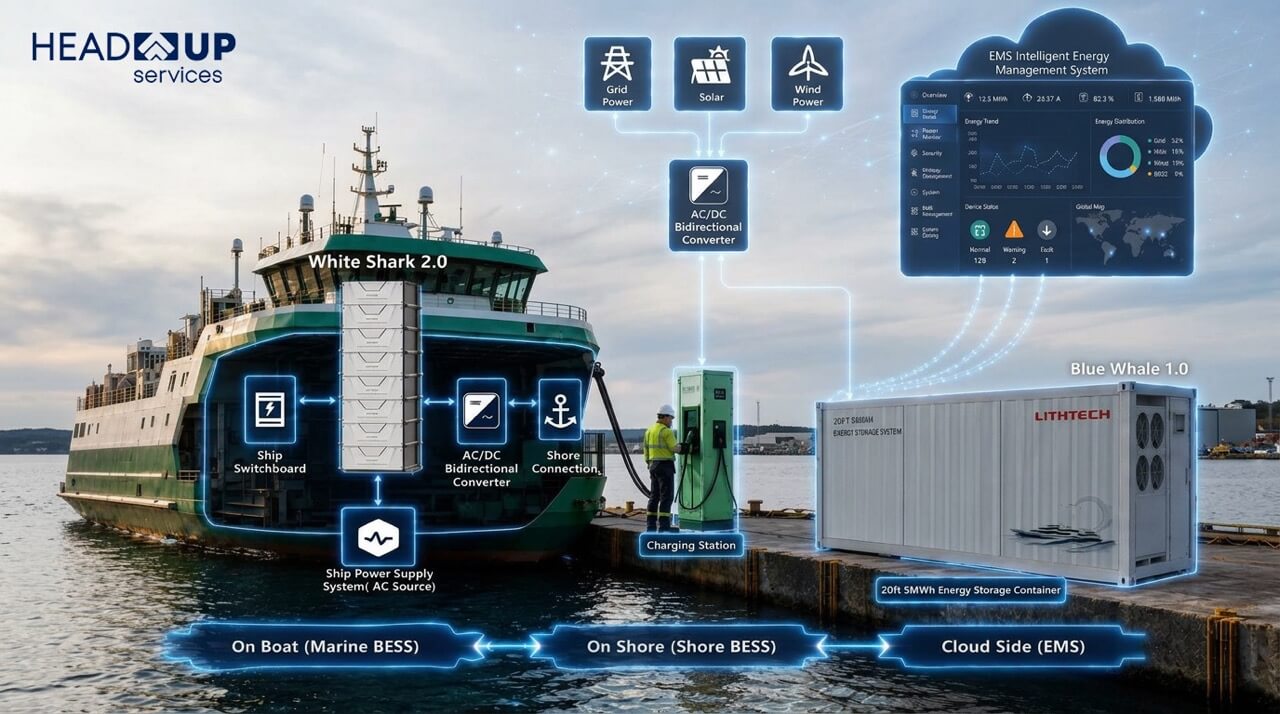
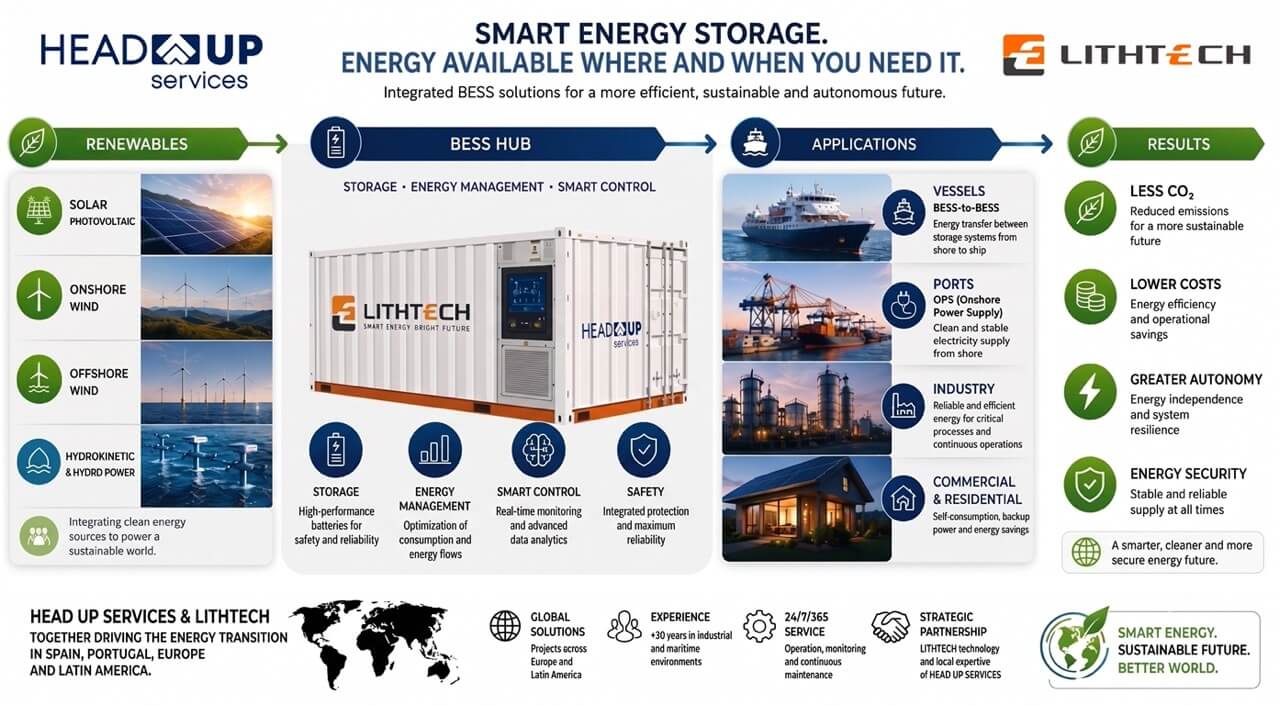
The implementation of Battery Energy Storage Systems (BESS) in the maritime sector enables the supply of energy both to OPS (Onshore Power Supply) systems and to the fleet itself during voyages, maneuvers, waiting areas in the port, and the last mile.
This approach ensures energy self-sufficiency and provides operational flexibility, combining different generation sources:
Onshore and offshore wind energy, harnessing steady winds for stable generation.
Photovoltaic energy, optimizing solar radiation on deck and within port facilities.
Hydroelectric power, connected to the local grid or micro-hydropower stations integrated into the port environment.
Hybrid systems, allowing batteries to be charged during navigation via auxiliary or main engines, reducing dependence on port infrastructure and maximizing fleet efficiency.
The integration of BESS in marine environments aligns with the decarbonization goals of the 2030 Agenda, promoting more sustainable, efficient, and resilient ports and fleets. This strategy positively impacts several Sustainable Development Goals (SDGs):
Climate Action (SDG 13)
Affordable and Clean Energy (SDG 7)
Sustainable Cities and Communities (SDG 11)
Industry, Innovation and Infrastructure (SDG 9)
With this model, ports and vessels can:
Minimize CO₂ emissions
Reduce ETS-EU penalties
Optimize energy efficiency
Preparing the maritime sector to be fully decarbonized, self-sufficient, and ready for the future of energy—combining innovation, resilience, and sustainability in every operation.
Download presentations
Request a proposal from us for your project